Wednesday, May 10, 2017
The Superheroisation of Politics & the 'Rule of Cool'
Wednesday, July 13, 2016
Non-Linear Borefare
Perhaps, though, 'strategy' is to some extent a misnomer. It's even possible that 'part' of the 'strategy' is to draw attempts to name it as such, attempts which can then be dismissed as egregious conspiracy theorising. The Corbynistas dreaming up conspiracies behind their laptops; the hard left caught in the ecstasy of their paranoia; the Trots twitching about the CIA. Prefabbed tropes perhaps, and we can recognise them as such when they're framed as starkly as this, but there's a form of truth there - the expectation of some kind of simple, yet obscure, causality which would produce a tidy explanation is naive in several ways. Ideology wants nothing less than for you to go looking for the individuals pulling the strings.
Instead, the dispersal of causality, or even its disintegration, characterises our particular phase of late modernity. Think of Adam Curtis' metaparanoiac discussion of Vladislav Surkov's 'non-linear warfare', which 'import(s) ideas from conceptual art into politics'. Now, whether you think Curtis is an inspired, if unconventional, cultural and political thinker, or a better-paid version of the worst stoner you ever met at university - and the truth is probably a mixture of 'both' and 'somewhere in between' - this notion of non-linearity, of a politics-by-other-means-by-other-means which disarms its opponents through depriving them of reliable concepts with which to respond, seems useful to me. (I think here also of Sianne Ngai's brilliant writing on modern conceptual art's deployment of minor affects - stupidity, envy, irritation - to frustrate our capacity to respond aesthetically or experience interpretative catharsis. What Ngai identifies as the 'stuplime' in Stein, Beckett and various points since is perhaps the foremost political affect of the 2010s.)
Now, there's obviously some distance between Putin's deck of techniques - stretching the concept of plausible deniability into psychedelic territory, creating situations (i.e. the murder of Alexander Litvinenko) which make diplomatic response more or less impossible - and those possessed by the chancers who make up the PLP rebellion and who fill the column inches in the nominally 'left' media. Nevertheless, we're often talking about people who have bathed in the reflected glow of Alastair Campbell and Peter Mandelson - or, indeed, actually are Alastair Campbell and Peter Mandelson - and it seems reasonable to assume that they've realised that because traditional spin no longer really washes, because everyone thinks everything is spin anyway, a new and more complex PR is required. Now, the aim is seemingly not to lie successfully, but to lie with such monumental transparency and such flamboyant non-conviction that the reality of those you oppose starts to unravel. Why, one wonders, hearing yet another political columnist insist that Jeremy Corbyn's diet, and his followers' alleged diets, renders him and them unsuitable for government, would anybody think this is true?
These are rhetorics not of deceit but of cumulative irritation. Twitter gives us Corbyn supporters as 'Momentum millionaires' (I personally feel lucky just to be able to pay twenty five quid to vote in the leadership election), a constant denial that Corbyn's supporters live anywhere but Islington or Brighton (fair cop there in this case, but clearly ridiculous more generally), the soft anti-Corbyn concern-trolling of the 'unelectable' sort, pantomimic outrage at John McDonnell swearing, various celebrities talking over our heads, albeit very and arguably unnecessarily visibly, about how the 'hard left' are 'out of touch with real working-class people'. Take those for a small-plate version of what's going on. For the main course, you could look at the systematic efforts to construct an image of Corbyn's support as misogynistic or anti-semitic, or - most did-they-really-do-that of all - the erasure of the political specifics of the horrible, horrible murder of Jo Cox in an incredibly spurious show of being frightened by 'Momentum thugs'.
There's probably plenty to be added here but all I really want to suggest is that this strikes me as a very wilful performance of stupidity which is expedient politically in the same way that Boris Johnson's (sorry) 'buffoonery' used to be. It riles, but also implicitly suggests that it is unanswerable, producing a feeling either of complete demotivation (what's the point in saying anything back to this?) or inchoate fury. We're caught in the trap of not knowing who believes what they say, of being unclear just how much this is an attempt to grind gears, and it's consequently difficult to frame a useful and coherent response. Regardless, this is a sophisticated act of reality management which (probably) lacks obvious evil geniuses: there is something weirdly organic about the growth of this form of verbal attrition.
Thursday, July 7, 2016
Language Without Apertures
Thursday, June 4, 2015
'Romantic and earnest, rather than laced with irony'
This in itself isn't what I want to unpick here: rather, it's an attempt to give some indication of the overall climate of the quasi-moral panic about 'hipsters' in the mainstream media over the last eighteen months. At this point, it's worth going full disclosure and stating that I feel like pieces I wrote played their own small part in this incredibly fucking tedious discussion, even though, in my defence, it wasn't really 'hipsters' as such that I was trying to critique in pieces such as this and this. Rather, it was the cult of the organic, acoustic and spontaneous that Alex Niven had spotted in his (brilliant and still wildly under-read) Folk Opposition, a text which did much of the key early work in figuring out the ideological dimensions of Cameron's Britain. Back then, I'd have tended to draw a fault line between the bearded ham enthusiasts of Borough Market and hipsters who, after all, I envisioned as the constituency of those articles. Indeed, although I've certainly used the term pejoratively myself, I'm pretty sure I'm a 'hipster' by my own relatively trad description: I listen to drone music and glitchy electronica (and, of course, mainstream pop), I read archly nihilistic American and European fiction, I'm a 'cultural professional', I quote Žižek with relative confidence. I am an archetypal Quietus reader as much as an archetypal Quietus writer, in other words.
Sunday, March 4, 2012
Big Society Microcosm #2 - Pret a Manger
On a coffee cup:
A mastery of dribble tests, button-holed cremas, milk frothing, steaming and stretching is absolutely fundamental to graduating as a Pret Barista. It takes about 12 weeks to create a perfect Pret coffee. Time well spent (we think).
Or, as a late-period J.H. Prynne poem:
A mastery of dribble
tests, button-holed
cremas, milk frothing,
steaming and stretching
is absolutely fundamental.
Etc etc. Practical criticism time: why is that parenthesised 'we think' so enraging? Qualifications of this nature seem rather common at the moment. They mean something like 'actually, the thing we said before the parenthesis was aggressively meant, but we want to remind you that it's your opinion that counts, whatever we believe, because, hey, everything's subjective, right?'
WE! ARE! YOUR FRIENDS! YOU'LL! NEVER! BE ALONE AGAIN!
And, once a bond of trust has been established between company and customer, we can get onto workplace politics. Pret's manifesto on napkins, printed - conveniently enough - on napkins:
This napkin is made from 100% recycled stock (Pret's sustainability department is militant, we're making headway). If Pret staff get all serviette-ish and hand you huge bunches of napkins (which you don't need or want) please give them the evil eye. Waste not want not.
Ready to explode yet? It's an interesting use of the word 'militant', isn't it? I mean, I suspect they aren't proclaiming their affiliation to Militant Tendency or the Naxalites or Sendero Luminoso or whoever. And that faux-chummy 'evil eye', when what they actually mean is 'give our staff a load of shit if they hand you one too many napkins' and 'criticise the individual, not the brand', just as NPower and so on ring themselves with a palisade of low-paid telephone operatives...
Wikipedia:
In 1998, [Pret a Manger] employed 1,400 people, of whom 19% were from the UK and 60% from other European Union countries, mainly in Eastern Europe.
John Berger, A Seventh Man:
A migrant's experience of capitalism, because he is exploited in every field, becomes, if he is politically aware of it at all, a very unified experience. In his life he is brought face to face, always negatively, with the unity of the entire system.
Wednesday, February 29, 2012
Big Society Microcosm #1 - The British Library
My observations suggest that the staff at the BL, particularly those who work in the reading rooms, are asked to put up with an unpleasant amount of rudeness, some of which is no doubt the venting of frustrations at a slightly absurd cataloguing and delivery system. The work is clearly difficult; the Mac-wielders (themselves symptomatic) who drift into the Humanities reading rooms to read two sentences of lecturer-prescribed Zizek and mess around on Facebook often make frustrating 'customers'. Immediately, there's an incommunicado between workers - particularly the security staff, I think - and a nominally liberal or leftish constituency of users, many of whom seem to be projecting a cultivated image of bookishness. I'm not sure if it was while I was living abroad that 'moderately dissident intellectual' became an off-the-peg look, and I know that going on about h*****s is basically the mark of the prematurely grumpy thirtysomething, but styling oneself after late-period (broke and tubercular) Orwell really seems to mark a new phase in the history of appropriation.
Anyhow, efforts to inhabit a vaguely-defined mid-twentieth-century thinkerishness are matched, with stunning predictability, by the BL's catering outlets, which are outsourced to Peyton and Byrne. Many people will already be aware of this, but P&B is a company dreamt up by a scriptwriter working on a satire of The Cameron Years twenty years from now, only it's somehow broken loose from its fictional moorings and travelled back in time as its owners thought we all needed a real-time encapsulation on the absolute cultural and political moribundity of the coalition years. It is echt Big Society in the same way as the pub in Goodnight Sweetheart was echt Myth of the Blitz, from the chummy 'X & Y'-formula name - a branding essential at the moment - to its gourmet fairy cakes and (of course) KC&CO font. This is what people who like books like to eat. People who like books like tea and cake. Books and tea and cake are bedfellows.
So, a downsized staff with concomitantly increased workplace stress levels catering to a politically-confused generation of depressive-hedonic studes while several outlets of a thirties-themed 'artisan' cafe rake in the profits that come with a semi-captive audience? That's Britain's 'intellectual heartbeat' in 2012. Please write to Jeremy Hunt about this, as if he'll pay any attention whatsoever.
Friday, January 20, 2012
How the Schools are Killing CREATIVITY!!!
It seems that Philip Hensher, one of those literary butterflies who seem to get an awful lot of press work without ever demonstrating a tremendous capacity for critical insight, has provoked what Private Eye might call a 'stir' with this rather scathing (and unpleasantly personal) review of the new UEA anthology. As assessments go, it's very much in the Christopher Hitchens tradition of using its subject predominantly as the occasion for a discussion of something to which it is linked only tenuously; this 'something', according to Giles Foden, is propelled by Hensher's bitterness over his failure to secure a chair in Creative Writing at UEA. Funnily enough, the review failed to mention this.
I spent a year as a faculty member in UEA's School of Literature and Creative Writing, and I suspect my suspicions about the merits of CW as a discipline were fairly obvious. During my interview for that position, I discussed what I saw as an increasing division between the critical and creative missions within the School, and argued that CW students and staff were endowed with a glamour that risked making the traditional activities of a Literature department look like donkey work. One of the main drawbacks of the proliferation of CW courses in UK universities has been to occlude the fact that criticism is in itself a creative discipline which draws on the same faculties of linguistic deftness and associative confidence that a poet or novelist requires to be successful. Indeed, coming to the work of close-readers like Christine Brooke-Rose, J. Hillis Miller, Maud Ellmann, or Margery Perloff (not to mention the scalpel-sharp analyses of poet-critics like J.H. Prynne and Keston Sutherland) is frequently more invigoratingly unsettling than going over the latest collection by a Bridport Prize hopeful whose verse allegedly 'reveals the magic of the everyday', or one more post-Sebaldian traipse through English marginalia.
The latter-day lionisation of creative practice as an academic discipline is also ideologically inflected in ways which strike me as not particularly subtle. By driving a wedge between 'criticism' and 'creativity', the academy implies that the critical thinker somehow lacks creative flair. In an age where every TV commercial seems to want to liberate our inner Picasso, and in which the inability to do that is portrayed as an ultimately limiting sense of self-doubt brought on by the critical superego (equated in Big Society's cultural logic, of course, with the alleged paternalism of big government), to 'lack creativity' is to suffer stigmatisation. What would be genuinely empowering, I think, would be a kind of left-Reithian approach to the teaching of literature which demanded that a large volume of reading be undertaken in order to bequeath a sturdy knowledge base from which further creative or critical (I'll repeat: the distinction isn't mine) projects could embark. Instead, there's an implicit message that degree courses which place a heavy emphasis on the creative can be flown through with only the briefest of dalliances with an extant body of work. The message of CW, on at least one level, is 'because you're worth it': there's a pandering to neoliberal subjectivity which nurtures a fantasy of the 'individual' whose experiences deserve to be expressed because they are more significant than social, collective experience. Personal experience is divorced from a social epistemology: I think György Lukács was wrong in his assessment of modernism, but his claims about its asociality could be transposed correctly for a study of the ideology of CW. (What I'm trying to say about the contemporary love of creativity is perhaps better expressed by Mark Fisher in this essay on psychotherapy.)
Returning to Hensher, then, I think his opening points make room for a broader discussion of the usefulness of CW courses in general, but don't pursue that path. UEA has, historically, probably done more than its competitors to ensure that transactions between the critical and creative maintain a certain fluidity - hence Angela Carter, Lorna Sage, Sebald, Vic Sage and a litany of others - and it seems to me that extra-institutional pressures are the predominant explanation for the increasing separation of the disciplines there. These forces have been generated by the determination of competing institutions to chase the quick buck with more straightforwardly 'creative' courses, something which Hensher clearly has no intention of acknowledging. What might have been an opportunity to have a serious conversation about the role of the market in undermining both components of the type of literary education being talked about is lost amidst snide claims about the merits of individual writers.
Thursday, January 12, 2012
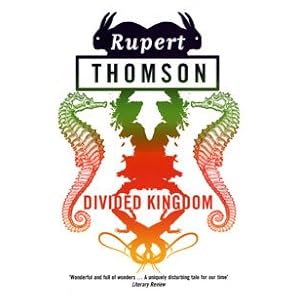
Rupert Thomson - Divided Kingdom (Pt 1)
Although Divided Kingdom's plot isn't particularly relevant to what interests me about it, which connects with these ideas about Adorno, Kafka, and Sara Kane, it's worth sketching in brief. In response to Britain's becoming 'a troubled place [...] obsessed with acquisition and celebrity [...] defined by envy, misery and greed', the government have implemented a 'rearrangement' in which the nation is quartered into red, yellow, blue, and green zones. These regions are populated according to temperament, with citizens of the old state being categorised after psychological assessment as choleric, phlegmatic, melancholic, or sanguine. Thomson's narrator is removed from home as a young child and packed off for a new life in the red quarter, the peaceful and unquestioning realm of the sanguine. On becoming an adult, he begins to work for a government agency involved in reclassifying and transporting problem cases. After crossing into the phlegmatic blue quarter for a conference, he finds his way into a mysterious nightclub in which he finds he is capable of recalling his childhood prior to the reorganisation: the experiences he has in this place cause him to embark upon a quest around the four sectors, pursued by secret police, in which he attempts to assert his right to live outside the absurd classificatory system.
Critics attempting to pin down Thomson's weird, roving, oneiric prose latch upon all kinds of comparisons. There are elements of Nabokov in his ability to load sentences with intimations of an imminent, yet indiscernible, disaster; his scrupulously-drawn characters have shades of Dickens (and perhaps Patrick Hamilton and Jean Rhys) about them; there are marked traces of Chandler, Kafka, Ballard, and perhaps Swift. To an already heady and incongruous-seeming mix, I'd add that his narrative structures, in which individuals are deprived of social reassurances as they range desperately across wide geographic canvases, recall William Godwin's Caleb Williams, as well as the late-thirties political allegories of Rex Warner and Ruthven Todd. His contemporaries, for my money, would be Paling and, at a push, China Miéville, although his novels don't seem quite as committed to the logic of low fantasy as those of the latter.
It's not hard to make it through one of Thomson's novels, either. 'Compelling' is a word used frequently when he's under review, and one doesn't struggle to untangle his language, which is never anything but lucid. Nicholas Royle - I presume the novelist and critic, rather than the critic and novelist, although I'm happy to be corrected on this - summed up Divided Kingdom's accessibility (there's no other word for it) in an Independent review which also attempted to get at what its apparently allegorical element was trying to communicate:
On one level, Divided Kingdom is a fabulous romp, an epic adventure story of flight and threat, fear and wonder, shipwrecks, espionage and breathless chase-scenes. On another it's a meditation on what it means to cross borders, to be alien, to seek asylum. It's a sly recasting of the nature versus nurture debate and a compelling account of personal development, of an individual's search for his own true temperament and identity.I don't necessarily have an issue with any of these claims: on some level, the novel is a simultaneously existential and political investigation of how one becomes and maintains a 'self'. Yet I feel that, in his attempt to translate allegorical content which is ultimately as accessible as the swashbuckling story which encodes it, Royle fails to demonstrate what the real challenge of Divided Kingdom, and indeed of everything I know of Thomson's work, is. The problem isn't to elucidate a meaning, but to describe an effect, to discuss what it is in the writing that, as Adorno said of Kafka's manipulation of toponyms, makes one 'shudder'. Like Warner and Todd, allegorists whose message was overwhelmingly clear, there's a surplus which doesn't seem to dovetail with any of the political or spiritual claims dispensed by the metaphorical structure, and this excess sets off a thrilling form of discomfort.
Everyone who was read to as a child is familiar with this feeling, and it often occurs to me that a desire to maintain it is what sets a certain kind of reader off along a trajectory which leads to (amongst others) Kafka, Beckett, Blanchot, and the nouveau roman. It's the experience one has when fiction peels away radically from the real world (or the world of literary realism) yet exerts a demand which prevents one from committing to a project of escapism. The ontological disjointedness suggests the legitimation of a demarcated fantasy world, a safe space in which postulations about truth and identity can be explored to their outer limits; the fact that the relentless rule-switching occurs, however, undermines one's sense of security because its refutation of real-world logic is imposed from the empirical world. Lewis Carroll's fiction, which, like Thomson's, sloughs off allegorical interpretation by dint of its excess of apparently translatable material, is exemplary of what I'm talking about here. I'll quote - experimentally - from Eric Rabkin's The Fantastic in Literature, if only to nominate a critic who I think is interested in emphasising the (perhaps embodied) experience and immediacy of reading over the intellectual activity of deciphering:
The fantastic is a direct reversal of ground rules, and therefore is in part determined by those ground rules. The truly irrelevant has nothing to do with ground rules, and therefore can no more be fantastic than it can be realistic. One may define the fantastic in part as 'conceived or appearing as if conceived by an unrestrained imagination' only so long as we remember that all imaginations are restrained at least by the perspectives necessary to create a work of narrative art.I need to go back to Rabkin to ascertain what he means by the 'truly irrelevant', but it's a term that lends itself to appropriation in this case. Thomson's writing is absolutely packed with events that gild themselves with the trappings of significance and yet are in no way recuperated into the narrative's structures of meaning. One way of describing this involves a bastardisation of Freud's notion of overdetermination, in which the proliferation of possible ideational content 'behind' or 'underneath' an image threatens to obliterate its capacity to signify. Another might be to say that the accumulation of the non-recuperable persists until it becomes structure, determined negatively.
This explanation works for Kafka and Beckett, and perhaps even for Harold Pinter, but when applied to writers who have something to say, either on a psychosocial level (like Henry Green, or Thomson) or a political one (like Warner, Todd, and Thomson again) it seems somewhat jarring. Why arrange an abyss which replicates in negative the coordinates of a determinate argument? Why undercut (what appears to be) a conviction with doubt? My sense for some time has been that Warner and Todd didn't do this on purpose: it was simply a happy accident that they lacked sufficient control as writers of fiction to keep on message, meaning that their readers are presented with texts presenting a challenge far more sophisticated than their authors envisaged. I can't lay the same charge of naivety at Green; Thomson, too, is far too erudite to be a structural savant.
Tuesday, January 10, 2012
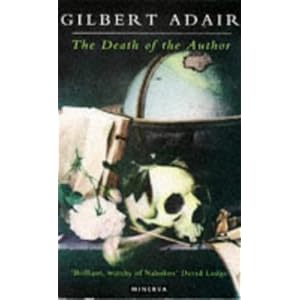
The Death of the Author...
I picked this up with a couple of other second-hand books on January 2nd, when I was still pretending that everything was free and easy and that I wasn't worried about work. The motive behind buying something by Adair was that, with the author having recently passed away, I thought it fair to give him another go after having been so critical of The Holy Innocents, which I read a few years ago.
The Death of the Author tells the story of Leo Sfax, an emigré professor of literature (with specific interests in Romanticism and literary theory) at a fictitious New England university. Having survived the Occupation in France, he has developed a considerable critical reputation in the United States, initially with an ingenious essay on Mallarmé but more recently with The Theory, an idea which dictates - you're probably way ahead of my conceit now - that authors are not stable entities that can be relied upon as sources of literary significance, but textual constructs who represent only one more deferral of meaning. As the narrative progresses, Sfax's recollections become increasingly candid, albeit without shedding a self-justifying defensiveness familiar to anyone who has read Lolita, and we discover that his wartime activity was based upon the production of articles for a collaborationist newspaper. While none of these pieces were even vaguely intellectually admirable, several were outrightly anti-semitic. When one of Sfax's admiring former graduate students preparing a biography on the esteemed critic, murders begin to shake the previously peaceful academic community.
It would be impossible for this snarky novella to be any more transparent about who and what is being 'satirised'. Obviously, the affair is given a touch of morbidly comic hyperbole once the killings start, but what precedes the swerve into melodrama follows the contours of the de Man affair pretty faithfully. Now, I'm no longer as strict an adherent to The Theory - The Theory in the novel being fairly identical with a generalised version of the one proposed by de Man in Allegories of Reading, albeit with a twist of Barthes for the purposes of simplification - as I once was, but The Death of the Author made me feel somewhat uncomfortable. Its Amisian irony failed, to me, to conceal an enraged conviction that, due to the poor judgement of de Man (and, in the context, only de Man) during the Occupation, it is impossible to separate poststructuralist claims about undecidability from fascism. I'm sure that there are those who read the novel differently, perhaps as a more subtle critique of the potential implications of The Theory on our sense of political responsibility, but, if they existed, these nuances were lost on me.
This depended on two things. First, the humour lacked gradation. The structure of the joke demanded a knowing recognition of the 'fact' that there were/ are only ever two kinds of theorist, namely the high-handed sophisticates like Sfax/ de Man and Anglophone camp followers converted in the wake of a collective cultural cringe: J. Hillis Miller, Frank Lentricchia, and Frank Kermode are all, I think, implicated in the depictions of the latter. These two caricatures - the nihilistic theoretical libertine and the elbow-patched bandwagon jumper - continue to act as bogeymen in journalistic discussions of theory, which have frequently pandered to (and propagated) chattering class anxieties about its (lack of) 'intelligibility'. Adair's writing plays to the gallery; given the depth of the author's understanding of French literature and culture (he translated Perec's La Disparition) this is rather sad, and for him to have played the satire this way indicates a genuine belief that the radical critique of literary meaning owed a debt to some form of totalitarian sentiment.
The other thing which caused me to doubt that Adair was willing to give theory the benefit of the doubt on any level was the novel's comprehensive failure to discuss the ethical concerns which dogged poststructuralism from the off. There's a Derrida figure lurking in its pages, but it's a version based entirely on several passages from 'Structure, Sign and Play in the Discourse of the Human Sciences' rather than on the Levinas-influenced philosopher of friendship, responsibility, and hospitality that emerged long before this text was written. In other words, the whole 'project' of theory is reduced to just that: radical thought is elided with right-wing political violence.
That's where the question arises. Did Adair alight on this interpretation via a consideration of de Man's biography or through an unpleasant encounter with the difficulty of his writing? Much of the hostility to theory begins with an insecurity about its impenetrability and then latches onto political, or pseudo-political, justifications. The critiques made by, say, Frederic Jameson of the essentialising relativism that poststructuralism appeared to justify are inspired efforts to resist the reification and commodification of continental theory, but one can't help but feel that the people who laughed hardest and most connivingly with this novel would regard Jameson, or Zizek, or Badiou as latter-day 'totalitarians' of complexity. Even though I share some of Adair's manifest reservations about the openness of The Theory to some shabby uses - after all, it has permitted a certain amount of 'it means what you want it to mean'-type answers in academic essays, the motor of The Death of the Author seemed to be, at root, a semi-populist, moderately anti-intellectual one.
Tuesday, January 3, 2012
I Could Have Been a Dog
why do a PhD/ when you could be a dog?
To all extents and purposes, my lack of secure academic employment seems to be caused by my rather problematic relationship with research publication. It isn't that I keep on trying and getting rejected - it's that I'm extremely unmotivated by trying in the first place. I have one paper coming out soon and a book chapter in the pipeline (I think); beyond that, I've submitted absolutely nothing to journals, nor have I attempted to publish my (increasingly motheaten) PhD thesis. While in academic employment, I've tended to con myself into thinking that teaching well is enough - and, given the Bartleby-like attitude to research 'obligations' held by some of the more venerable members of Lit departments, it clearly once was - and, while otherwise employed, I've been liable to wonder what the point is of this form of publication altogether.
It probably hasn't helped my cause that my political attitude towards my work has altered fundamentally since I completed. When I submitted my PhD proposal in 2003, I was a bushy-tailed advocate of what I now recognise as the worst kind of reterritorialising, American postmodernism. What I saw as 'the political' in literature seemed grey and limiting; I partook instead in an entirely clichéd celebration of lacunae and aporias, a celebration which failed on every level to identify what might be political about non-meaning. I think the fantasy that each text has the capacity to eradicate its own political implications as a facet of its own (highly desirable) quality of infiniteness was a common one among starter postgraduates even as late as the early 2000s; I can only offer as a defence the fact that I briefly discussed an anxiety about this inverted idealism at the beginning of my Introduction. As this detail suggests, it was only during my final year of study - with the Credit Crunch and Cameron looming - that third-hand de Manisms began to look rather unattractive. Since then, I've been carrying a fair old weight of doubt about the general worthwhileness of a project that still carries the traces of these ideas (a project, furthermore, that, in order to lay claim to critical honesty, must incorporate an analysis of what was attractive about third-hand de Manisms in the first place).
A second, also political, rationale for failing to make headway with my research lay, or lies, in my unease about the wider project with which I was involved. I'd been encouraged to submit my thesis proposal as part of an exciting effort to get a 'neglected' set of authors 'recognised', a mission statement which, to twenty-two year-old ears, sounded noble if not completely radical. In retrospect, the critical reinvestigation of late modernism in Britain has been, by and large, rather disappointing. On one hand, it has constantly strived to 'rescue' figures from the allegedly tainted grasp of experimental modernism, delivering people as different as Elizabeth Bowen and Graham Sutherland to the safe, tea-and-biscuits world of Englishness Studies. Jed Esty's A Shrinking Island was a core work for this rather dubious movement, which seems to have garnered some extracurricular impact through Alexandra Harris' Romantic Moderns, a text which seems to me to offer a striking embodiment of the cultural logic of Big Society. On the other hand, the work of 'rediscovery' seems ultimately to have served in the creation of new markets for publishers, who relish the opportunity to give us 'Vintage Hamilton' or 'Vintage Taylor' with some atrocious parody of Vanessa Bell splashed across the cover. In short, it feels at the moment as if the only way to participate in my field at the moment is as a scorn-pouring naysayer, churlishly refusing such self-regarding 'redefinitions of the canon'.
All of the above probably gives the impression that I'm rather uneasy with participating at all in Literary Studies in the form it currently takes in UK HE institutions. This is, on some levels, a reasonable assumption; nevertheless, there's still a sense that something rather fundamental is missing as long as I'm not participating. I wonder about the extent to which this is to do with the experience at the core of the PhD process, which is a form of training which - I believe actively - seeks to introduce an epistemological break into one's life. The first year of a PhD seems more or less designed to fill the candidate with the conviction that they will be incapable of completing the thesis: thanks to supervisory eyebrow-raising and the occasional glimpse of the exhausted final-year student, the finished article becomes inflected with the sublime qualities of Everest or Mars (the annoying PhD Comics contributes to this mythology). To compensate for this, one either quits or sets about an obsessive redressing of their 'ignorance', a process which entails not only learning everything there is to learn about the research topic in question but subjecting every notion - literally incorporating everything from John Berger's views on Picasso to what to have to supper - to critical assault. By the end, you probably have a PhD, but you've also become rather distanced from people who (understandably) want to be able to drink a cup of tea without going through some abstract intellectualisation of the china industry.
I want to be critically rigorous: I've accepted it as a kind of double-edged outcome of the initial - not too well thought-out - decision to do a PhD. But, once you encounter any situation in which the ability to slice and splice ideas isn't making money, you're perpetually haunted by the sense that someone is going to turn around and say 'and look where it got you!' I try and explain to my family that I say what I say about Downton Abbey because I've been trained to do it, just as an electrician is trained to spot faulty wiring; however, the instant I lose a financial justification for having had this training is the moment at which I open myself to allegations that my points are entirely 'subjective', that we're 'all entitled to our opinions', and other such commonplaces of essentialised relativism. There's been plenty of discussion about the financially-precarious positions PhD students find themselves in after completing theses; I'd venture that there is a direct correlation between this and a genuinely-precarious sense of identity. I can't find the exact links, but K-Punk has written some fine posts over the last few years on the anxiety many feel about performing intellectual work in a society which audits itself on purely financial terms. It's probably this I'm trying to get at: in this climate, how do you rid yourself of doubts about the value of writing critically if the activity is not being financialised in some way? How much good work is strangled by the sludge of 'subjectivity'?
Most likely this is all a pep talk to persuade myself to properly pursue a project - not necessarily, or not entirely, academic - this year which goes beyond the short bits of journalism I wrote for the TLS and The Quietus in 2011. Blogging regularly would be a start: I disappointed myself repeatedly by my inarticulacy in the face of subjects that would once have triggered a kind of writing reflex (this Quietus piece was a last-minute attempt to redress this). No promises, though, either to myself or others.
Sunday, November 6, 2011
Anchorage III
Anchorage iii
See? Major innovations in dock/
shoal architect/ skål/ with the underbite
you’re the breed, squat angle containment.
And I reckon on north-west location and
I reckon those trapped in floe can be christ-
ened: he really thinks the gathering whalers
press in, press in like what breaks on Flannan
or in anthrax remission. If the CPO lands
on the hemispheric mat? A timer -
committed once to the unsealing of
delicacy, now to the national projekt –
is fixed into the cliff; below the bars
on hair-trigger, on demand, on something
anticipating, most of all, wordbreak.
Friday, November 4, 2011
Anchorage II
Anchorage ii
Z only point seaviews north north east as
spectrum pilot/ the five-mile inland NDB
locks coarse awareness of traffic’s actual
& massive scale. Before the pier read where
the underwriters were, reet from Godthåb
to Archangel under the parabolae of a)
something mythic & 2) able archer arc.
We say ’radio silence’ when really we’re
pissed off. More beautiful if cut here –
oh, breakdowns need vocabulary, though,
and I’ve only bluish flint, the trails and scales
of great migrations and strategic geography.
These angles of blue crates stamped for longing
and range, their implied sightlines dwindle.
Wednesday, November 2, 2011
Anchorage I
Anchorage
S/he couldn’t find a single inelegant
sentence in the fiat – where the burn
outs the combe is the outmost part
of the MSA’s leverage; where we find
lucidity, on the tarmac, you dreem sonar.
Stir at SeaTac?? Antiflash and aluminium
abstract in the radiopharm, in Nixon’s HUD
this journey’s long, cuts continental corners
through the frigid zone and the cold
contracts. Screems in dead playgrounds.
Here no-one fucks in the afternoon,
there’s no rubbish and rime
even is managed: you’re shocked when
tangerine ripples the blue recording.
Thursday, May 5, 2011
Collected Articles, 2009-2011
Review of Žižek's First As Tragedy, Then As Farce - 3AM, November 2009
Review of Andy Beckett's When the Light's Went Out - 3AM, March 2010
Review of Max Schaefer's Children of the Sun - Quietus, April 2010
Review of Dominic Fox's Cold World - 3AM, June 2010
Review of David Stubbs' Fear of Music - 3AM, July 2010
Review of Tom Raworth's Windmills in Flames - 3AM, July 2010
Interview with Mark Fisher/ K-Punk - 3AM, July 2010
Review of Žižek's Living in the End Times - 3AM, September 2010
Anniversary piece on Slint's Spiderland - Quietus, April 2011
Honestly, the Josipovici piece is on its way, and I'm also really enthused by the idea of writing something on Exile, that not-entirely-successful Paul Abbott thing that's just been on the BBC.
Thursday, April 28, 2011
I stepped out onto the midway...I was looking for the pirate ship
Friday, February 18, 2011
Lake Como, Lower Edmonton, Elland Road
All his stories take place in the same spaceless space, and all holes are so tightly plugged that one shudders whenever anything is mentioned that does not fit in, such as Spain and southern France at one point in The CastleAdorno, 'Notes on Kafka'Adorno's discussion of Kafka's geographical, or toponymic, affect identifies a complex instance of the modernist uncanny. His description of the 'shudder' experienced by the reader when Kafka's fiction - and, indeed, Kafkan fiction - inscribes itself into the spatial relationships of the (theoretically) non-literary is something I find to be surprisingly accurate: when, right towards its conclusion and in the form of K's Italian visitor, The Trial admits itself to geography's frame of reference, one can't help but feel a creeping sense of untowardness. Why? An explanation of the mechanics of the situation begins with reference to genre: what one responds to is a redrawing of textual regulations typical of real Fantasy; we're moved by a spontaneous-seeming alteration of what had appeared to have asserted its claim to be the organising linguistic perspective of the novel (that is, a linguistic perspective that can't see outside the hermetically-sealed 'spaceless space' of the Kafkan city). In synchronising ourselves with the The Trial's elaboration of an entirely immanent topography - its fundamental prozess -which permits no extensions into a social or historical megatext, we learn to forget to believe in the very possibility of these extensions. The ground of the writing is the writing itself, so when 'our' world smuggles itself back into the text it feels as if we've fallen through a trapdoor back to ourselves.
That said, I don't think that Adorno's insinuation that the 'shudder' takes place because 'it' - Josef K's persecution; K's insinuation into the rhythm of deferral - is 'happening here' is entirely correct. We are generally sophisticated enough to perceive some sort of ontological difference between place-names in a work of fiction and place-names on the map, however open to problematisation this distinction might be; we're (mostly) aware before reading the novels that the mingling of inexplicable cruelty and officiousness that's the bare truth of Kafka's world is also characteristic of ours. The surprise, in other words, isn't the Planet of the Apes-style revelation that we were at home all along, but the disestablishment of a literary code which discreetly works as a metonym for the principle of ordering knowledge. The first, 'spaceless' code nominates literariness as what is stably separate, while its sudden citation of a geographically-informed (cultural) code repositions this separateness as a socially-necessary fantasy. It's only in the inversion of image of the stably literary or poetic achieved by its idiomatically-inapt citation of a culture not immanent to it that the work reclaims its autonomy as the space of social critique; that is, it's the shattering of the epistemology of 'spacelessness' it offers to the reader that maintains it as spaceless.
This move is one that's fundamental to Beckett's Endgame, Pinter's The Birthday Party, and Kane's Blasted. In Endgame, it's only through Nag and Nell that there's any reference to an exterior which, unlike the purely elemental outdoors glimpsed in Hamm's story, is substantiated with human significances:NELL: It was on Lake Como. [Pause.] One April afternoon. [Pause.] Can you believe it?
NAGG: What?
NELL: That we once went out rowing on Lake Como.
The difference between Beckett and Kafka's attitude towards the geographic is that Endgame internalises the reader's disbelief at the intrusion of the toponym - never mind if Nagg can, are we able to 'believe' that this is a world in possession of a Lake Como?
Something similar occurs in The Birthday Party, when Stanley Webber discusses his musical (non-) career:STANLEY. [...] I've played the piano all over the world. All over the country. (Pause.) I once gave a concert.
MEG. A concert?
STANLEY (reflectively). Yes. It was a good one too. They were all there that night. Every single one of them. It was a great success. Yes. A concert. At Lower Edmonton.Pinter's mechanism enjoys as subtle a difference from Beckett's as Beckett's does from Kafka's. While the spacelessness of The Trial is well-established by the time of Italian visitor's arrival, and Endgame - partially by dint of a paratextually-gained sense of how Beckett 'works' - seems to come off the map almost before it has begun, Pinter's disestablishment of the literary only works when this conversation is looked to retrospectively, after the ontologically-troubling arrival of Goldberg and McCann. Stanley and Meg's interchanges are certainly weird and disconcerting, but, paradoxically, the world of The Birthday Party only comes to seem hermetic after it has been violated. Blasted follows the example set by Pinter: the Soldier's intrusion into Ian's hotel bedroom establishes it as a hermetic, literary, space precisely because he arrives as a deserter from an unnamed war which bears the marks of allegory rather than historicity. The inspecificity of the historical rules of the outside - what is the 'organisation' than Goldberg and McCann work for, and why is there a war in Blasted? - insists that the precursors of these institutions and events are those things possessed by Kafka's notoriously vague definite articles.
When audiences of The Birthday Party and Blasted realise that the terms were Kafkan all along, they shudder at the recollection of the plays' appeals for a naturalistic extension. When, in Kane's play, Ian and Cate debate the value of going to Elland Road to watch Leeds play on a Saturday afternoon, the dyke of the geographic text bursts: if there's a Lake Como there's a Maggiore, if there's a Lower Edmonton there's a Chingford, and if there's an Elland Road there's a Hillsborough. And yet it's these refusals of a particular kind of hermeticism which give them, via the fracture brought about by the citation, their truly antithetical status.
Wednesday, February 16, 2011
In which Mogwai are linked tenuously to Sarah Kane
The reality is that they've been a band in search of a formula ever since the early EPs, and that they've always struggled to synthesise their influences to a point at which their albums belie the presence of an underpinning idea. Come on Die Young , produced in the isolation of upstate New York by Dave Friedmann, just about managed this by dressing sepulchral instrumentation, played at the geological pace of Codeine or Low, with virtually inaudible samples and electronics. Its bursts of noise - the reverberating wash of 'Ex-Cowboy' and the Iommi-esque riffing in 'Christmas Steps' - responded organically to a context, and the one track to feature singing - the semi-eponymous 'Cody' - used vocals as a kind of how-to guide for the record's audience (the second verse begins 'When I drive alone at night'; one can't help but feel that the song is describing how and where it wants to be heard). Every other Mogwai album has slung together disparate approaches to make something that sounds a little like a primer for a catholically-compiled listen-before-you-die handbook to the forty years of music that preceded it. I owe my appreciation of everything from The Fall to Model 500, from Labradford to Art Ensemble of Chicago, to my having bought Young Team on a whim when I was seventeen, but Mogwai have never come close to seeming vital in the manner that all of those bands have.

Hardcore Will Never Die, But You Will, their new record, doesn't mark a departure from this trend, but it seems, surprisingly, to have harnessed it as something like a virtue. The stylistic leaps that occur between tracks are no longer apologetic but flamboyant: 'Mexican Grand Prix', a decent enough exercise in motorik drumming and Farfisa, gives way to 'Rano Pano', which would only need a little more fuzz to resemble Earth. 'San Pedro', halfway through, shapes like a superior Screaming Trees in search of a Lanegan vocal, while the subsequent 'Letters to the Metro' returns to the Dirty Threeisms of Come on Die Young. It feels as if variousness has become the formal principle here, in contrast to earlier efforts on which the incongruity of the tracks was a by-product of an attempt to harmonise style. I don't think that this is reducible to well-worn clichés about postmodernist strategies of citation, though: it's more the case that Hardcore Will Never Die, But You Will operates as a retrospective investigation of the band's own inability to make an architecturally-sound object of their inspirations. While wary of the current tendency to use 'hauntology' as a justificatory descriptor of works which dip in and out of various pasts - I'm still to be convinced of the merits of the Ghost Box project - it strikes me that Mogwai have reached a point at which their music serves to interpret its own history. The album's obvious points of fracture speak of roads not travelled, of colours not pinned to masts.
If they have indeed reached such a level of self-awareness, Mogwai have produced an incisive comment on the decade which gave birth to them. In Britain, the 1990s, at their best, were all about attempts to marry eclecticism to a rejection of cheap irony: one aspect of millenial thinking was that the preceding hundred years of cultural production needed somehow to be collated and made available for assessment. I was reminded of this in November when I went to see a revival of Sarah Kane's Blasted at the Hammersmith Lyric. Famously, Blasted was hammered by critics on its debut, with many reviewers (not all of them working for the usual suspects) reducing the play to an assemblage of shock tactics in the épater la bourgeoisie tradition. Even more sensitive responses couldn't help but feel that it was something of a mess that resulted from a young writer grappling with the weight of her precedents. Sean Holmes's new take on the play has forced something of a reassessment, with various writers - and there seems to be no small measure of hypocrisy in this - looking to rectify their attacks on Kane.
I'd never seen Blasted before, so my own reaction might as well have been to a new play. As I expected, I was rattled by it, particularly after the jerk away from realism it makes once the imposing Aidan Kelly's unnamed soldier bursts into the Leeds hotel room where Ian, a rat-arsed, paranoid journalist, has just raped Cate, his epileptic teenage lover. After this point, the reference points come thick and fast: the soldier's sucking out of Ian's eyes asks us to remember Oedipus and King Lear, while the closing scene sees the protagonist neck-deep in a hole which burrows towards Beckett's Happy Days. One might also point out that the unexpected violation of a narrowly-delimited setting by a character who at least feels ontologically incongruous nods towards Pinter's early work, and that Ian's resentful ranting and multifaceted scheming makes us wonder what might have happened to Jimmy Porter had he grown up to work for the Yorkshire Post. As some find with Pinter, the uneasy mixing of classical unities, historically-aware naturalistic allusions (at one point, Ian and Cate argue about Leeds United's hooligan problems), and late modernist disjunctions makes the audience ask if too much is being attempted.
Ian's sub-philosophical diatribes, however, permit a reading of Blasted in which it becomes apparent that Kane was seeking to make a point about what happens when artworks are subjected to reductive, appropriating interpretations. Stuck in his pit, water tipping onto his face from some unseen source, the journalist announces the impossibility of salvation as if he's making the point that's always on the tip of the tongue of Beckett's characters. This proclamation of the non-existence of god seems, for him, to retrospectively justify his earlier behaviour: he's got his head round a (small) portion of Existentialism's argument, but failed to grasp its attendant ethical implications. Kane was perceptive in her understanding that the anti-theology worked out by Existentialism and Absurdism might, in the wrong hands, be perceived as a liberation from ethics, an invitation to perform actions which affirm nothing but the rejection of any principle of consideration. Given the geographical setting of Blasted, and the protagonist's name, it's hard not to see in this evacuation of responsibility a hint of Ian Brady; there's also a veiled critique of the surreptiously nihilistic doctrines of Thatcherism. Kane cites Beckett, but in a two-handed way which demands that his work either maintains or acquires a politics: the play's climax effectively reverses the movement typical of postmodernist quotation by reinstating political or ethical imperatives which seem to be on the verge of departure.
We're reaching a stage at which the aesthetics of the nineties are going to come under scrutiny in terms of how they responded to a historical climate which arguably didn't make a lot of sense at the time. Blasted dealt with the Balkan wars by suggesting that they were the decade's political unconscious: in this performance, Kelly's Northern Irish accent is used to imply that the only way that Sarajevo and Srebenica could be interpreted while they were happening was in the unsatisfactory vocabulary of a more proximate example of civil unrest. Kane's work might, then, be thought of as putting up a resistance to failures to think in either historical or political terms which were encouraged by the governments of the era and bolstered 'intellectually' by postmodernism's partialised accounts of Existentialism. Contemporary accounts of hauntology, which seek to repotentialise citational aesthetics for political critiques, might do well to go back to works which might, at the time, have felt like marginal agitprop.